Snow started falling over Centennial before sunrise. By the time you merge onto C-470 from University Boulevard, the overhead sign is flashing three words you have seen many times and maybe never fully read: Traction Law in effect. Your coffee is still hot, your wipers are working hard, and one question is suddenly very loud. Does that sign mean me?
Short answer: When the Colorado Traction Law is in effect, every passenger vehicle on that highway needs tires with at least 3/16 inch of tread that are rated for all weather or winter driving (M+S, M/S or the mountain-snowflake symbol), or chains or an approved alternative traction device. CDOT can put it in place on any state highway. If your car, truck or van gets stuck or breaks down in the snow, Golden Performance Towing Services is available day and night at (720) 586-4629.
What the Colorado Traction Law Actually Says
The Traction Law is the first step the Colorado Department of Transportation takes when snow and ice make a highway risky. It does not close the road. It sets a minimum standard for the equipment on your vehicle, so one car with bald tires does not stop hundreds of other drivers behind it.
According to the CDOT Traction Law page, a passenger vehicle meets the law when it has one of these:
- Tires with at least 3/16 inch of tread depth that are rated all weather or winter, shown on the sidewall as M+S, M/S or the mountain-snowflake icon.
- Chains on the tires.
- An approved alternative traction device, such as a tire sock. CDOT keeps a list of approved products.
CDOT says it can put traction and chain laws in place on any state highway. On I-70 between Morrison and Dotsero, the rules can be enforced from September 1 to May 31, or whenever conditions call for it. For drivers in the south metro, that matters most on weekend mountain trips, because C-470 feeds straight into I-70 near Morrison.
Traction Law vs. Chain Law: The Levels for Passenger Cars
There are two levels for passenger vehicles, and they are easy to mix up when you are reading a sign at highway speed. The table below sums them up.
| What the sign says | When CDOT uses it | What your vehicle needs |
|---|---|---|
| No restriction | Normal winter conditions | Nothing extra is required, but good tires still help |
| Traction Law | Snow or ice makes the road risky | 3/16 inch tread on all weather or winter tires (M+S, M/S or mountain-snowflake), or chains, or an approved traction device |
| Passenger Vehicle Chain Law | Severe winter storms | Chains or an approved alternative traction device on every vehicle |
| Road closed | Conditions are too dangerous | Wait it out and check COtrip.org or call 511 |
CDOT calls the Passenger Vehicle Chain Law the final safety step before a highway is closed. If you see it posted, good tires alone are no longer enough.
CDOT also lists the fines. Not meeting the law is a $100 fine plus a $33 surcharge. If an unprepared vehicle ends up blocking a travel lane and the lane has to close, the fine is $500 plus a $157 surcharge. Trucks and other commercial vehicles have their own chain rules, so commercial drivers should check CDOT before every winter trip.
How to Check Your Tires Before the Next Storm
Most drivers in Centennial have never measured their tread. That is fine. It takes about two minutes in the driveway.
- Read the sidewall. Look for M+S, M/S or a small mountain with a snowflake inside it. Many all-season tires carry the M+S mark.
- Measure the tread. A tread depth gauge from any auto parts store reads in 32nds of an inch. The law asks for 3/16 inch, which is 6/32. Check the inner, middle and outer grooves on every tire.
- Look at the wear bars. Those small raised bars across the grooves sit far below 3/16 inch. If the tread is close to them, the tire is past the line for winter roads.
- Check the pressure. Cold air lowers tire pressure. Use the number on the sticker inside the driver door, not the number on the tire.
If one tire is flat or badly worn when you find it, do not try to drive on it to the shop on an icy morning. A tire change puts your spare on where you are parked, and a tow can take the car to your tire shop if the spare is also low.
AWD and 4WD Help, but Tires Do the Gripping
Plenty of Front Range drivers think all wheel drive solves everything. CDOT does highly recommend AWD or 4WD in the mountains. But the drive system only decides which wheels get power. The tires are still the only part of the car touching the road, and they are what help you stop and turn on packed snow on Arapahoe Road.
So an AWD SUV on worn tires can climb a hill nicely and then slide right through the light at the bottom of it. Think of AWD as a helpful extra, and the tread and tire rating as the part the law cares about.
What to Do If You Spin Out, Slide Off or Stall
Even careful drivers end up on the shoulder sometimes. If it happens to you, these steps keep you safer while you wait.
- Turn on your hazard lights right away.
- On a busy highway like I-25 or E-470, stay inside with your seat belt on unless the car is in danger. Passing traffic is the biggest risk.
- Do not keep spinning your wheels. It digs the tires deeper and can overheat the transmission.
- Do not try to push a car on ice. People get hurt that way every winter.
- Make sure the exhaust pipe is clear of snow if you run the engine for heat.
- Call for help and give your location: the road, the direction, the nearest exit or cross street, and the mile marker if you can see one.
What you need depends on what happened:
- Slid into a snowbank or a ditch, with no damage: a winch-out can pull the vehicle back onto solid ground.
- Car, SUV or pickup that will not drive: light-duty towing on a flatbed or wheel lift.
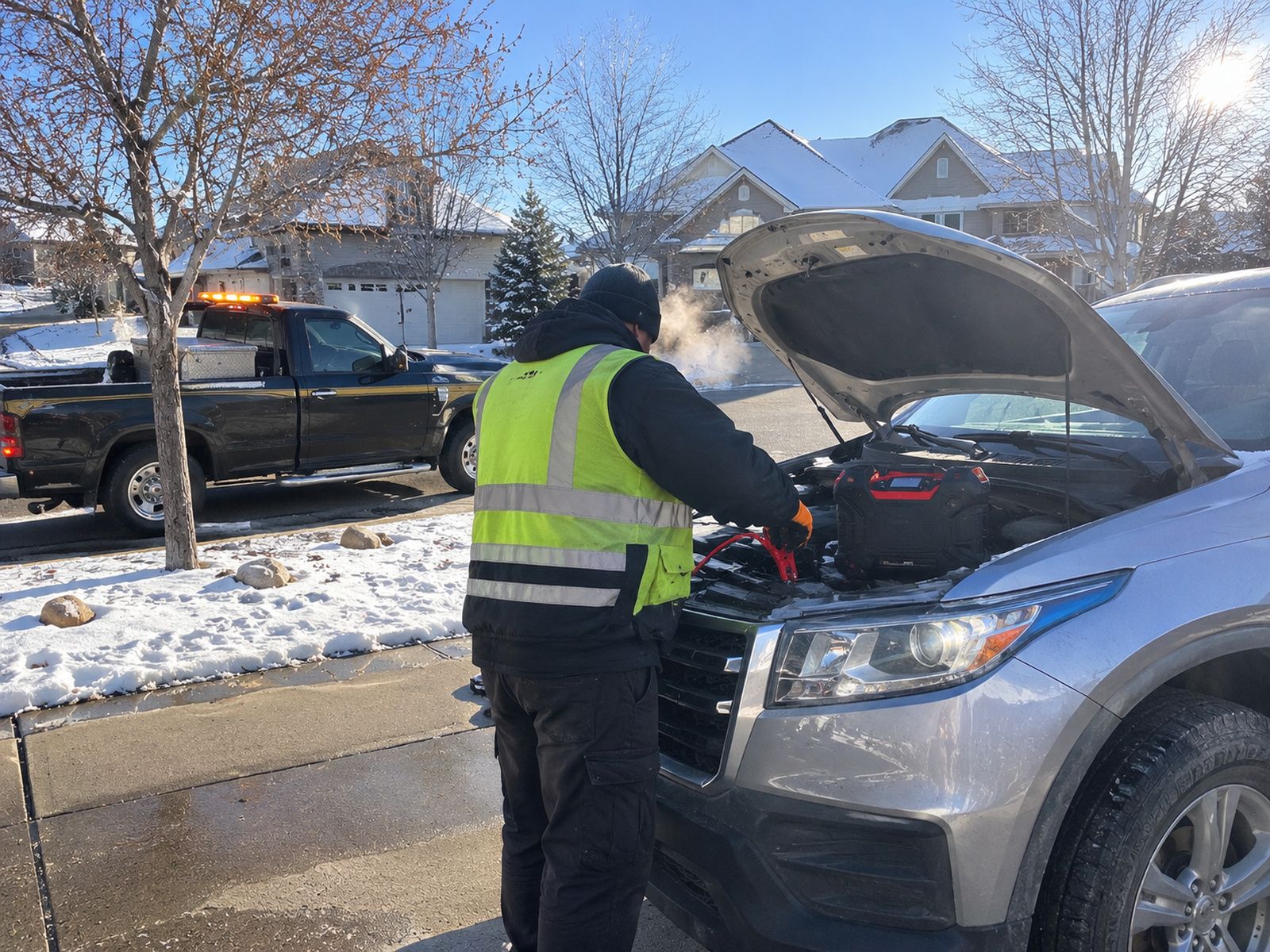
- Battery gave up in the cold: a jump start where you are parked.
- Ran low on gas while sitting in a long backup: fuel delivery.
Box Trucks, Work Vans and Big Rigs
Heavier vehicles have a harder time in snow. A loaded box truck or a motorhome carries a lot of weight, and once it slides off the pavement it takes the right equipment to get it back without more damage.
For box trucks, work vans, motorhomes and small buses, we use medium-duty towing. For heavy trucks and big rigs, we bring heavy-duty towing equipment rated for the load. If you drive for work around the Denver Tech Center, Dove Valley or the warehouses near Centennial Airport, save our number before the next storm, not during it.
In Centennial and Across the South Metro
Most of the time the Traction Law shows up in the mountains, but snow days in the south metro bring their own trouble spots. Here are a few places where drivers often struggle:
- C-470: the main route west toward I-70, and the road many drivers use to reach the Traction Law zone near Morrison.
- Arapahoe Road and Dry Creek Road: stop and go traffic, lots of lights, and plenty of chances to slide at an intersection.
- County Line Road near Lone Tree and Highlands Ranch: busy shopping traffic and hills that get slick fast.
- Parker Road and E-470: open stretches toward south Aurora, Southlands and Parker, where wind blows snow across the lanes.
- I-25 through the Denver Tech Center: heavy traffic, so any stop on the shoulder needs extra care.
We serve Centennial, Dove Valley, Englewood, Greenwood Village, south Aurora, Parker, Littleton, Highlands Ranch and Lone Tree. See our towing in Centennial page for more about our home area.
A Winter Checklist Before You Leave
- Check road conditions on COtrip.org or call 511. CDOT posts active Traction Law and Chain Law alerts there.
- Measure your tread and read your sidewalls, as shown above.
- If your tires do not qualify, keep chains or an approved traction device in the trunk, and practice putting them on in your driveway first.
- Keep at least half a tank of gas. Long backups burn fuel while you sit.
- Charge your phone and pack a blanket, water, gloves, a scraper and a small shovel.
- Save (720) 586-4629 in your phone under Golden Performance Towing Services.
How Golden Performance Towing Services Can Help
Golden Performance Towing Services is based in Centennial and is available day and night. We handle light-duty, medium-duty and heavy-duty towing, plus Roadside Assistance: jump starts, tire changes, car lockouts, fuel delivery and winch-outs. If the snow wins this round, call (720) 586-4629 and tell us where you are and what you drive. You can also reach us through our contact page.
Colorado Traction Law FAQs
Does the Colorado Traction Law apply in Centennial?
CDOT can put the Traction Law in place on any state highway, so it can apply anywhere conditions call for it. It is used most on I-70 in the mountains, where it can be enforced from September 1 to May 31 between Morrison and Dotsero. Check COtrip.org before you leave.
Are all-season tires good enough for the Traction Law?
They can be. CDOT accepts tires rated all weather or winter, marked M+S, M/S or with the mountain-snowflake symbol, as long as they have at least 3/16 inch of tread. Check both the sidewall and the tread depth.
Is AWD or 4WD enough on its own?
CDOT highly recommends AWD or 4WD in the mountains, but the Traction Law still points to your tires: 3/16 inch of tread on all weather or winter tires, or chains or an approved traction device. Worn tires on an AWD vehicle still slide.
What is the fine for breaking the Traction Law?
According to CDOT, not meeting the law is a $100 fine plus a $33 surcharge. If an unprepared vehicle causes a travel lane to close, the fine is $500 plus a $157 surcharge.
Can you tow a box truck or semi that slid off the road?
Yes. Golden Performance Towing Services offers medium-duty towing for box trucks, work vans, motorhomes and small buses, and heavy-duty towing for heavy trucks and big rigs. For a vehicle stuck in snow without damage, a winch-out may be all it needs. Call (720) 586-4629.